Restaurant Books CleanupFour totals before Saturday closes
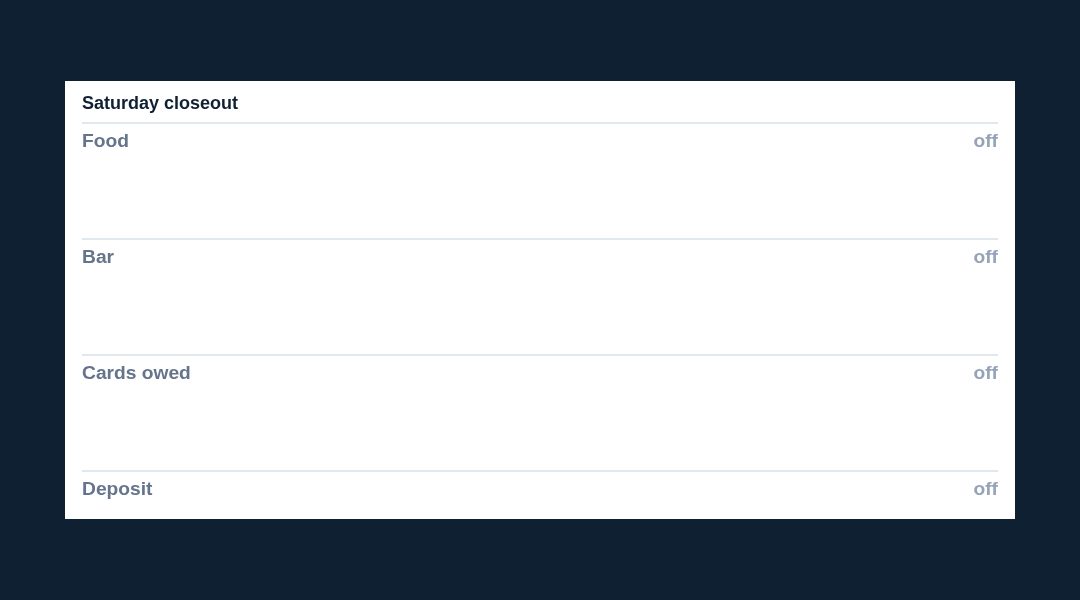
Food, bar, gift cards still owed, and the bank deposit. Four totals that have to agree before Saturday is closed. We line the four totals up on one sheet, leave payday with the provider already in the restaurant, and build the return only after those months agree. Steven Palmieri, the Tax CFO, reads the closeout with you on a shared screen.
A bookkeeper gets Saturday's four totals to agree. The Tax CFO reads a month of Saturdays and asks whether food margin is moving, whether the bar is carrying the room, whether the owner is being paid through payroll or through the register, and what October says about the year.
Food, the bar, the unspent card, and the deposit are the four decisions we keep apart.
A Saturday that will not close stays noisy until the four totals meet on one sheet.
1Food on one return
Food on one return
Plated meals and boxed meals share one food column on the Saturday sheet. Bakery goods that leave with no plate and no utensil are the exception a state food publication may allow, and that exception is read from the publication that wrote it.
Keep that food figure in its own column before anyone adds the bar.
2Alcohol on two forms
Alcohol on two forms
Drinks finished in the dining room stay off the food column. A state alcohol report, where the state has one, is its own monthly paper, and the guest's piece can be a second paper. Each location lists liquor, beer, and wine on separate lines of the closeout.
Name the permit on the wall before those forms are filled.
3A card still owed
A card still owed
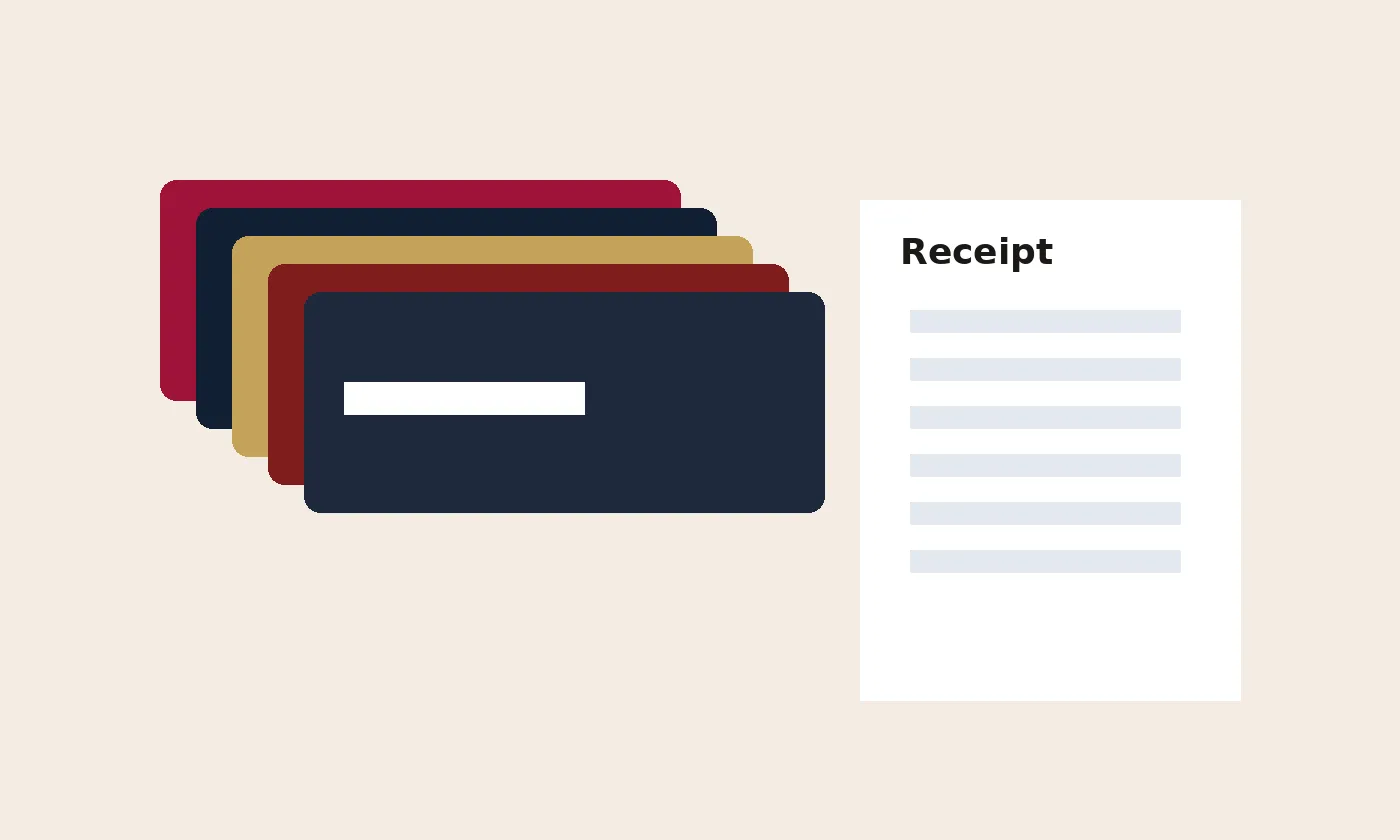
Selling a gift card or a certificate does not make tonight's food larger. The meal is the sale when the guest spends the card. Booking the sale as food on day one inflates the month.
Leave the unredeemed balance as a liability until it is spent.
4The deposit after the fee
The deposit after the fee
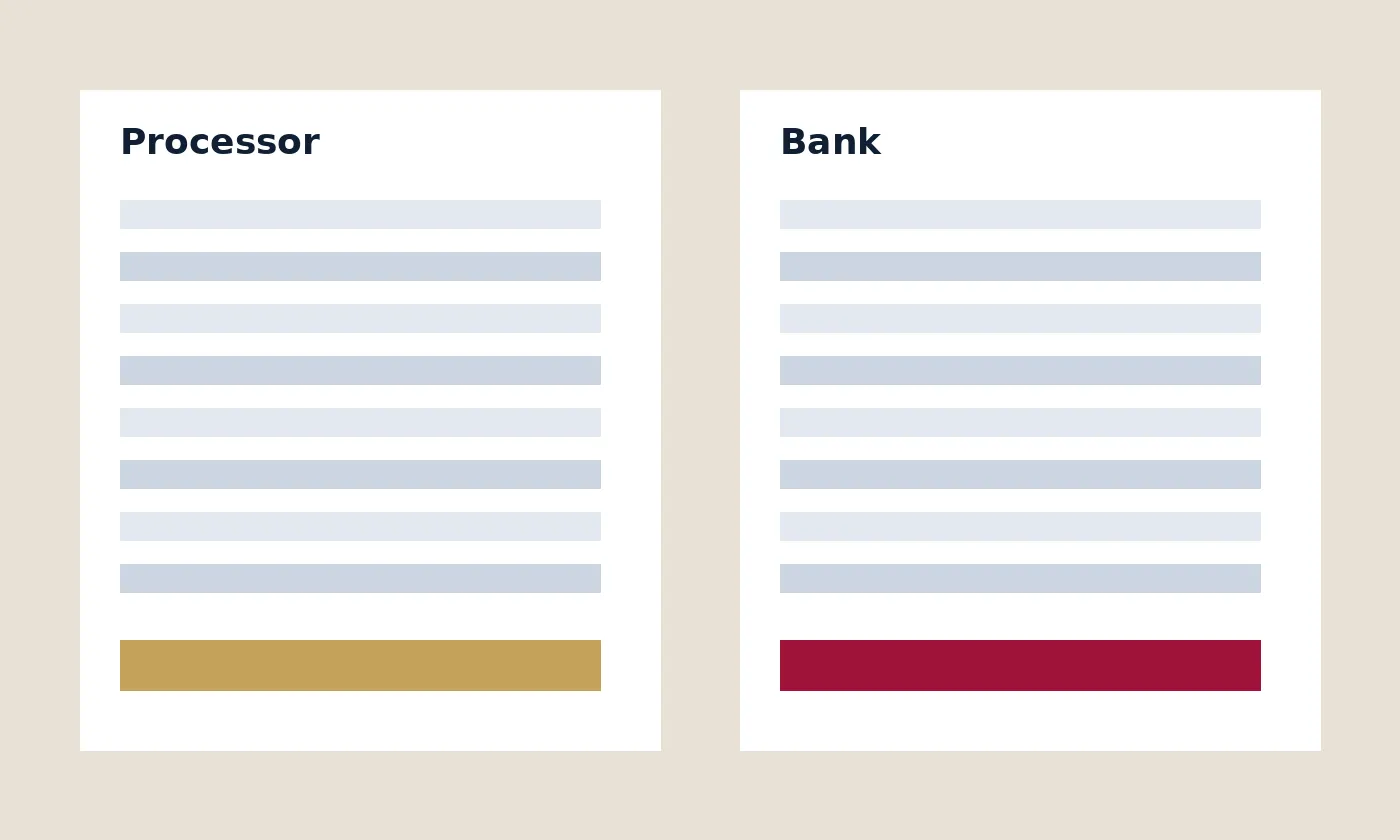
The closeout total and the amount that reached the bank are two labels. The gap is the fee the processor kept, and that fee is the restaurant's cost of taking the card.
Stop calling the bank deposit the sales figure.
5Written tips by the 10th
Written tips by the 10th
Once cash tips from this employer reach 20 dollars in a calendar month, the worker writes the total down by the 10th of the next month. A service charge is pay, and it is not a tip.
Ask whether those written reports exist for last month.
6A zero bar still has a line
A zero bar still has a line
A bar that poured nothing still needs a line on the close. A state drink report, where the state has one, keeps its own due date, and a zero month does not erase that date.
Steven Palmieri, a Tax CFO and the Entrepreneur's CFO, reads the closeout with the owner on a shared screen, and the dining room stays where it is.
Food and alcohol, two returns
Steven Palmieri, a Tax CFO and the Entrepreneur's CFO, lines up food, on-premise alcohol, unredeemed cards, and the bank deposit, sets payroll up with the provider the restaurant already runs, and prepares the return from a month that already agrees.
An accountant stops at the drawer that already locked. A Tax CFO chooses the four labels the next open Saturday has to be ready to show.
Food sits on its own line of the Saturday sheet, apart from the bar. The deposit is what reached the bank after the processor kept its fee. The unspent card waits until a guest spends it on a real plate.
A plated meal and a boxed meal can share one food column once the kitchen has finished the food. Bakery goods that leave with neither a plate nor a utensil are the carve-out a state food publication may name, and that publication is the one to open. If Saturday's drawer adds drinks poured for the dining room into that food figure, the sales column is asked to carry alcohol it does not own.
Each location should list liquor, beer, and wine as their own lines on the closeout before any return is opened. A point of sale that pours all three into one alcohol bucket will not line up with a form that wants them apart. The federal return does not sort that bucket. The Saturday sheet does, while the month can still be changed.
Ice and mixers poured into a drink the guest finishes at the table ride with that drink, not with the food. A charge the house builds into the menu price stays inside the price. A charge printed as its own line on the check is a different label. The close picks one habit and keeps it, so next month is not a new argument about the same drawer.
Beer and wine follow the permit on the wall, and the permit is a state paper. Under one permit those drinks belong on a state alcohol report. Under another they follow ordinary sales tax. A bottle that leaves for a porch or a delivery car, and is never opened in the dining room, stays with the food column rather than with drinks finished at the table. Naming the permit is the first sentence of the fix.
A house that is excused from sales tax on some plates can still owe a separate report on drinks finished at the table. The guest's piece and the house's piece are not the same tax. Even a bar whose only sales are drinks often needs a sales tax permit before a state alcohol packet will be accepted. Those facts are read from the publication of the state that asked. This page keeps the columns apart so that publication has an honest close to land on.
The federal half of a restaurant close includes IRS Topic 761, the written tip report, and Form 8027 where the house is large enough to file it. Intuit owns the QuickBooks name. These pages are unaffiliated, and the clicks inside a software menu are a different phrase that is not taught here.
Why the deposit is not the sales
Owners sometimes treat the amount that hit the bank as the sales figure. The close keeps both numbers. The closeout total is one label. The amount that reached the bank is another. The gap is the fee the processor kept, and that fee is the restaurant's cost of taking the card.
A card fee added on the guest check is part of the sales price under the way sellers generally treat a fee that is in the price. This page does not hang a separate card-fee ruling on the restaurant notes, because those notes do not carry one. The two labels are enough to stop calling the deposit the sales.
A deposit is not income just because it arrived. Gift card cash, a loan, an owner transfer, and a processor deposit can all land in the same account. The monthly close ties the bank to the labels, and a feed that dumps every deposit into sales will inflate the month. That is the same discipline a bank reconciliation is for, applied to a Saturday batch.
How often a seller files a state sales return depends on tax paid in that state's prior year. Some states close the door on paper once the prior year is large, and some require an electronic payment above a higher mark. Those marks belong to the state publication. The filings can be prepared only after the close exists. The close is not the filing. A confirmation from a state agency does not fill a federal date, and a federal acknowledgment does not prepare the state report.
Gift cards stay a liability
Selling the card or the certificate does not make tonight's food larger. The meal is the sale when the guest redeems the card. Booking that sale as food on day one inflates the month and moves the sale to the wrong day. The close keeps a liability until redemption, and the liability is what a later Saturday has to be able to prove.
When the house eats the discount and nobody pays the house back, the books follow the cash the guest actually handed over. A coupon the house funds reduces the amount recorded as the sale. A two for one plate is recorded on the plate that was paid for, and the unpaid plate is not a sale. A meal paid with a food benefit card is kept on its own line when that meal is one the benefit program allows, so the sales column is not asked to do the benefit program's job.
The close names the card, the coupon, and the free meal as their own lines so a sales return is not asked to do their jobs. Which day a state starts tax on a redeemed card is that state's publication. On this sheet the liability starts the day the card is sold and ends the day a real plate leaves the pass.
Tips due on the 10th
A guest who adds a tip by choice does not turn that tip into food sales. A required gratuity is wages when the house imposes it, and wages are not a tip. The check should print the words tip or gratuity when the house wants the line read as a tip, and the money should reach the people who customarily serve the table. A required charge the house keeps is pay, and pay is a different column from the food.
A service charge the house requires is wages from the first dollar, whoever later receives a share. Those amounts cannot be used in the section 45B credit, because they are not tips. Who may stand in a tip pool is a payroll question. Whether the line was food is a closeout question. The Saturday sheet answers the second one before anyone opens a return.
By the 10th of the following month, anyone whose cash tips from this one employer reached 20 dollars writes the total down for the house. That written total covers what guests left in cash, what the house paid out from charged tips, and what a tip share passed along. A month that stays under 20 dollars is not written up for the employer, though the worker still reports that income on the worker's own return.
A service charge or an automatic gratuity is wages, not a tip. Those amounts cannot be used in the section 45B credit, because they are not tips. The credit itself equals the employer share of Social Security and Medicare tax paid on creditable tips, claimed on Form 8846. For 2025 through 2028 a worker may deduct qualified tips up to 25,000 dollars a year, with a phaseout when income is over 150,000 dollars, or 300,000 dollars on a joint return. Qualified tips are voluntary, and they have to show up on a W-2, a 1099, or Form 4137.
Under the Fair Labor Standards Act an employer who takes a tip credit must pay a cash wage of at least 2.13 dollars an hour, and the credit cannot exceed the gap up to the 7.25 dollar federal minimum. A state may require a higher cash wage than that federal floor, and the payroll provider the restaurant already runs is where that wage is entered. Directly supporting work, such as rolling silverware, loses the tip credit when it is more than 20 percent of the tipped hours in the week or runs more than 30 continuous minutes. Payroll is set up on a provider the restaurant already runs. Running the actual pay stays with that provider.
A zero bar still needs a line
A bar that poured nothing still needs a line on the close. Leaving the line off because the number is zero is how a later report gets skipped. The report a state asks for on drinks finished in the room has its own due date, and a zero month does not erase that date. Turning the zero in early may earn no discount. Paying early may earn none either. The close writes the zero down so the date is not a surprise on the morning it is due.
A state publication may walk an included-price night with its own base and its own rates. Those figures stay on the page for that state. This sheet does not borrow them and does not invent a dining room that owns them. Saturday's closeout peels plated food into the food column and leaves drinks finished at the table in the alcohol column.
A week spent rebuilding both columns from the point of sale is a week when payroll tax can already be late. Written tip reports are due on the 10th. The state drink report, where the state has one, keeps the date that state published. The close names both dates on the same sheet and does not let one confirmation stand in for the other.
Comps and shift meals
A meal or a drink the house gives away is not a sale on the Saturday sheet. Give away a soft drink and the cost is the syrup or the bottle the house used up. Raw meat and raw vegetables inside a free plate stay off the sales column. Free drinks can still be listed where a state report asks to see them, and the ingredients the house consumed show up as a purchase, not as a guest check.
Meals furnished to restaurant employees right before, during, or right after a shift are not taxable sales when they are for the restaurant's convenience and the employees prepare or serve food. Publication 15-B treats meals furnished to a food service employee on that same timing as for the employer's convenience, so the value can be excluded from wages. A meal for a manager who never prepares or serves food is a different question, and this page does not answer it.
Paper napkins, plastic forks, straws, and fry bags that leave with the guest are often bought for resale, and a state may ask for a resale certificate before the seller skips the tax. Ovens, fryers, grills, and slicers that cook food for sale may qualify for an exemption certificate the state publishes. A hand tool often does not. Tables, chairs, plates, glasses, silver, reusable menus, cloth napkins, the dishwasher, and any box that only holds finished food are usually taxed when the house buys them. Gas and electricity that keep the room running are usually taxed. So are pest control, security, janitorial work, waste hauling, landscaping, and repairs to the building. When an out of state seller skipped tax on a taxable purchase, the house can still owe use tax to the state where the kitchen sits. Equipment bought without sales tax remains an asset when the income tax return is prepared. The certificate rules of a particular state are read from that state's publication, not guessed from a Saturday drawer.
Form 8027 and the 8 percent
A large food or beverage establishment files Form 8027 for each location when tipping is customary, food or beverages are consumed on the premises, and the employer normally employs more than ten people who together work more than an average of 80 hours on a typical business day. The form is due the last day of February, or 31 March if it is filed electronically.
Form 8027 compares the tips the house reported with 8 percent of food and beverage receipts. Boxes that left the building, and checks that already carry a service charge of 10 percent or more, stay out of that 8 percent math. A card-tip percentage that towers over the cash-tip percentage is the usual sign that cash tips never got written down. Any allocated amount lands in the allocated tips box on Form W-2, and the house withheld nothing on it.
The 10th is the federal date that makes the tip report real. Written tip reports are due on the 10th. A state drink report, where the state has one, keeps its own date even when the bar line is zero. A week spent rebuilding both from the point of sale is a week when payroll tax can already be late, and the federal return is not the paper that fixes a skipped state report.
The entity return comes after the month
The entity return comes after the month agrees. Form 1065 is how a partnership reports the year, and Form 1120-S is how an S corporation reports it. On a calendar year both are owed on the fifteenth day of the third month. Form 1120 is the C corporation return, and a single member company that never elected anything lives on the owner's Form 1040. Both of those are owed on the fifteenth day of the fourth month. If that fifteenth falls on a weekend or a legal holiday, the date you want is the next morning the Service is open. A state entity report, where the state has one, is a different pile and a different month.
Form 7004 can extend the entity return. Form 4868 can extend an individual return. An extension does not postpone tax that was due on the original date. Estimate checks for an individual owner go out in April, June, September, and the following January. None of those federal dates prepares a state report, and a state confirmation does not prepare Form 1065, Form 1120-S, Form 1120, or Form 1040.
A food safety certificate is a kitchen fact, not a credential of this practice. A permit to operate a dining room is issued by the health authority that covers that address. Fees and exemptions live on that authority's page. The close can note whether the permit is in the drawer. It does not turn a food safety card into a license to sign a return.
After a return is already filed
Moving food, tax, or a gift card between months can change a figure a return already used. The close is finished on paper first. An amendment is one path. Leaving the filed period and correcting forward is the other. This page names both and picks neither until the years are on the table.
No hour band and no dollar range is printed here. The counts are the locations, the months since the four totals last agreed, whether state drink returns were filed, whether gift cards were booked as sales, and whether Form 8027 exists. Until those five counts are on the table, this address does not name a price.
For a tax year beginning in 2025, section 179 expense is limited to 2,500,000 dollars, reduced when the cost of section 179 property placed in service exceeds 4,000,000 dollars. Property that qualifies, when it is bought and placed in service after 19 January 2025, may take the full extra first-year write-off of 100 percent. That is a federal asset rule. It does not sort the four totals, and it does not close a Saturday by itself.
Bring last Saturday's sheet.
Name the permit if you know it, and say which total fought the deposit.



 Steven Palmieri, a Tax CFO and the Entrepreneur's CFO, lines up food, on-premise alcohol, unredeemed cards, and the bank deposit, sets payroll up with the provider the restaurant already runs, and prepares the return from a month that already agrees.
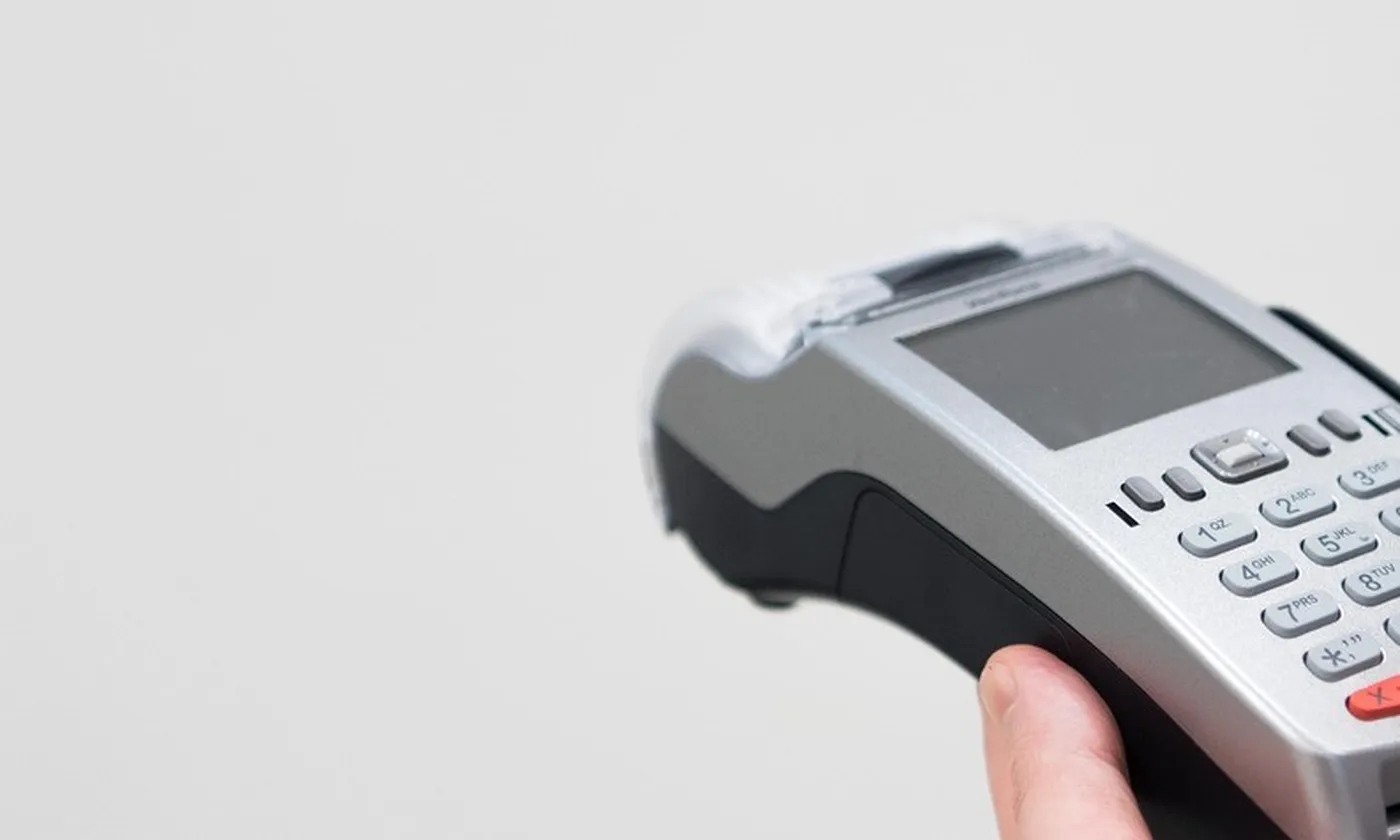 Owners sometimes treat the amount that hit the bank as the sales figure. The close keeps both numbers. The closeout total is one label. The amount that reached the bank is another. The gap is the fee the processor kept, and that fee is the restaurant's cost of taking the card.